

How The Schumann Protected 1M+ Bees and Inspired Its Community to Take Action
The Schumann turned World Bee Day into a verified impact campaign customers could see, join, and celebrate
- +22%Conversion Rate Lift
- +63%Add-to-Cart Rate Lift
- 1,131,120Bees Protected
- 18+Hives Funded

About The Schumann

The Schumann is a wellness brand built around the relationship between people, frequency, and the natural world.


On this page
Campaign overview
When The Schumann started planning its World Bee Day campaign, the goal was not simply to run another seasonal promotion. The wellness brand wanted to create something meaningful for its community, connected to its products, and true to its belief in the relationship between people and the natural world.
The campaign needed to be commercially strong, but it also needed to feel genuine. Customers had to understand what they were supporting, how their purchase contributed, and why the cause belonged to The Schumann in the first place.
With Greenspark, The Schumann turned that idea into a live impact campaign. Customer actions were connected to verified bee protection, with real-time progress shown across the shopping journey. By the end of the campaign, The Schumann’s community had helped protect 1M+ bees and fund 18+ hives. At the same time, the campaign delivered measurable improvements across key customer journey metrics, including a 22% lift in conversion rate, a 63% increase in add-to-cart rate, and a 51% increase in reached-checkout rate.
The campaign proved something powerful: when impact is specific, visible, and connected to customer action, it becomes more than a sustainability message. It becomes a reason to engage, trust, and buy.
At a glance
- +22%Conversion rate
- +63%Add-to-cart rate
- 3.8×Public goal exceeded
- +170%Email attributed revenue
- +51%Website sessions
- +11%Average order value


Verified on-site
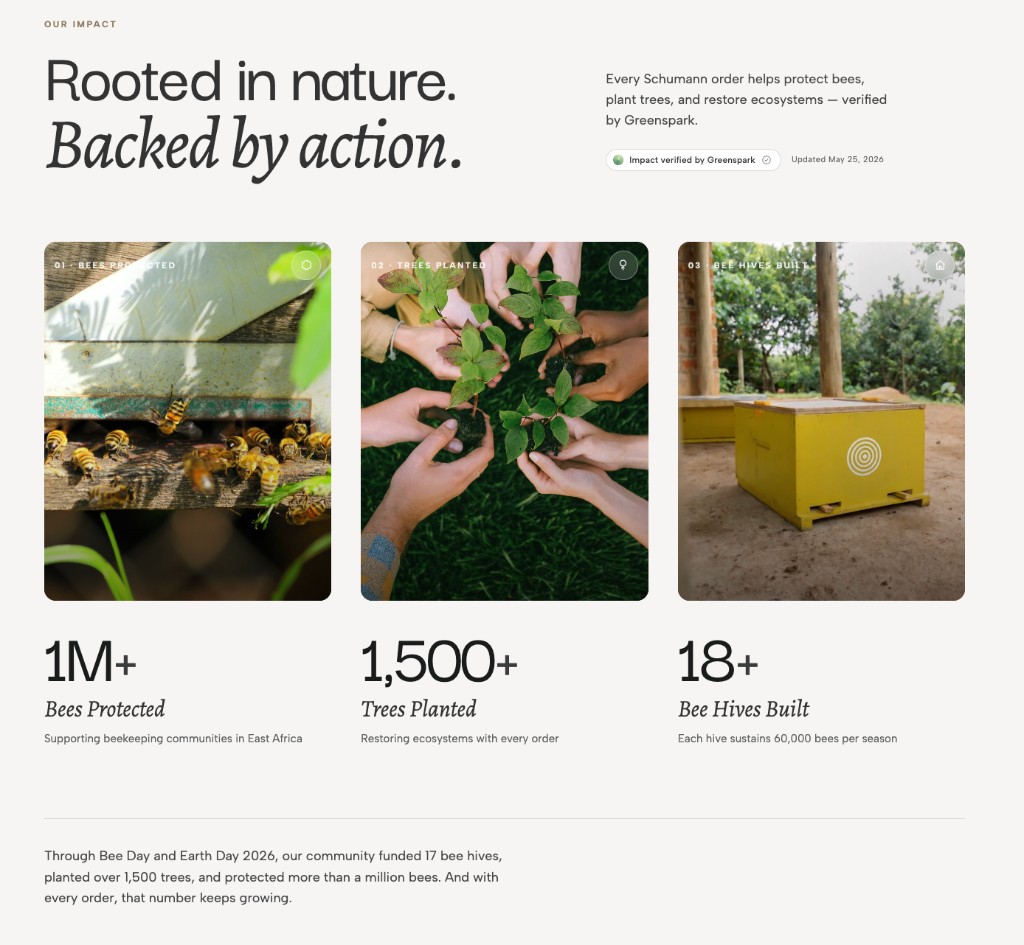
Rooted in nature. Backed by action.
The Schumann's campaign brought together bee protection, tree planting and ecosystem restoration into one clear impact story, verified by Greenspark. The impact summary gave customers a credible, always-on proof point they could revisit throughout the campaign and beyond.

About The Schumann
The Schumann is a wellness brand built around the relationship between people, frequency, and the natural world. Its community includes athletes, executives, parents, creatives, practitioners, and people looking for practical ways to create better environments in the spaces where they live and work.
Nature is not a side theme for the brand. It sits at the centre of how the company thinks about wellbeing, the environment, and modern life. That made sustainability a natural extension of the brand’s wider mission, but the team also knew that sustainability messaging needs proof. Broad claims can easily feel abstract, and The Schumann wanted something customers could see, understand, and participate in.
That is where Greenspark came in.
“If we genuinely believe in the importance of reconnecting with nature, then caring about the health of that natural world is not optional. It is a direct extension of what we stand for.”
Visible, specific and on-brand impact
Many sustainability initiatives sit outside the customer journey, they live on a separate page, in a brand statement, or in a post-campaign report. Even when the work behind them is meaningful, customers may never really feel connected to it. The Schumann wanted the opposite.
For World Bee Day, the team wanted an impact campaign that felt relevant to the brand, easy for customers to understand, visible in real time, and present across the journey where people were already browsing, considering, and buying.
The timing was perfect
Otto Winfried Schumann’s (the German physicist whose work on the Earth’s natural electromagnetic resonances inspired The Schumann’s philosophy and after whom the brand is named) birthday falls on May 20, the same date as World Bee Day. But the fit went deeper than the calendar, since bees are closely linked to biodiversity, food systems, and the health of natural ecosystems. For a brand built around nature, environment, and the signals that connect living systems, bee protection felt like a cause that belonged.
The project also gave customers something concrete to rally around. A specific goal, a live counter, and a visible outcome. The original public goal was to fund 5 hives. By the end of the campaign, the community had helped fund more than 18. That made the impact easy to understand and celebrate.
Why The Schumann chose Greenspark
The campaign needed more than a pledge message. It needed verified impact, real-time visibility, and customer-facing tools that could work across the campaign journey.
Verified impact
Trackable results The Schumann could stand behind publicly.
Relevant project
Bee protection through Earthlungs in Kenya, with hive-level outcomes.
Customer-facing tools
Live progress, campaign messaging, on-site placements, and email-ready content.

“Greenspark gives us verified, trackable impact that we can stand behind publicly. For a brand built on authenticity, that matters enormously.”
How the campaign worked
The campaign used a simple two-tier impact mechanic: every order contributed to bee protection and campaign bundles contributed even more.
Save X% · Protect Y bees
This connected the customer benefit with the impact benefit in one easily understandable sentence. People could see the offer, understand the cause, and know what their purchase helped support.
Crucially, the campaign was not built around impact alone, the bundles were commercially compelling, and the mission gave them an additional layer of meaning. Verified impact does not replace strong products, good merchandising, or a clear offer. When the connection is credible, it makes them more meaningful.
| Customer action | Impact mechanic |
|---|---|
| Any order | 1 bee protected per dollar spent |
| Campaign bundle order | 3 bees protected per dollar spent |
| Campaign goal | Fund hives and protect bees through Greenspark |
| Live progress | Bees protected and hives funded shown during the campaign |
Impact showed up where customers were already paying attention
The campaign worked because their impact became a core part of the entire customer journey, from browsing and comparing products to checkout, email, and social.
Campaign landing pages
Bee Day story, campaign goal, and live progress
Introduced the mission and gave customers a place to engage
Homepage banner
Bee Day campaign entry point
Made the campaign visible to site visitors
Product pages
Campaign bundles and impact-led product recommendations
Connected impact to product discovery
Cross-sell modules
Bee Day bundles shown as native recommendations
Helped customers discover higher-impact options
Cart drawer
Bee protection messaging close to checkout
Reinforced the mission at a high-intent moment
Klaviyo flows
Campaign messaging in welcome, abandoned cart, and post-purchase emails
Extended the impact story beyond the website
Campaign emails
Launch, progress update, and final-call sends
Gave the team a reason to communicate beyond a standard promotion
Paid ads
Bee Day creative across acquisition channels
Expanded campaign reach
Organic social
Campaign updates, feedback, and community conversation
Turned the campaign into a shared moment
 Introduced the mission and gave customers a place to engage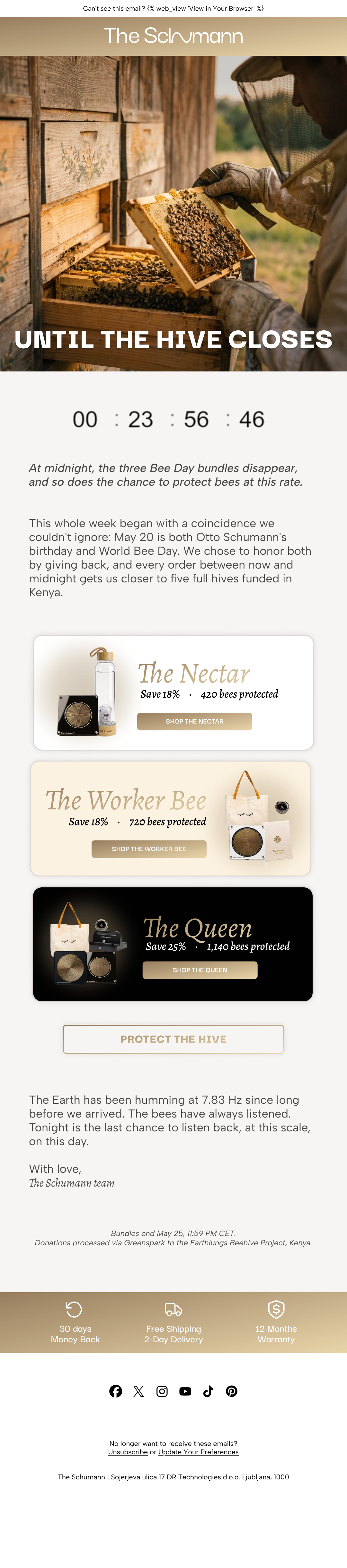

Real-time progress made the campaign feel shared
As customers participated, The Schumann showed progress toward its bee and hive goals in real time. When milestones were reached, the team increased the goal and kept the community involved.
This turned the campaign from a one-way sustainability message into a shared community moment. Customers could see the impact growing, understand how their purchase contributed, and follow the campaign as it moved beyond its original goal.
For customers, that made the purchase feel more meaningful. They were not just buying during a promotion, they were helping protect bees and fund hives through a campaign they could see, join, and celebrate. That changed the feel of the campaign, allowing the community to watch the numbers move together.

- Original public goal
- 5 hives
- Final result
- 18+ hives funded
- Goal exceeded
- 3.8×
The results
The Schumann’s World Bee Day campaign created meaningful impact and measurable customer journey improvements during the campaign window. Public results use only verified impact outcomes measured and reported by Greenspark and The Schumann after the campaign.
Impact outcomes
- 1,131,120Bees protected
- 18+Hives funded
- 207kgPotential honey per season
- 912.5MEstimated flowers pollinated per season
- 3.8×Public goal exceeded
Customer journey outcomes
- +51%Website sessions
The campaign increased attention and traffic
- +22%Conversion rate
More visitors became customers during the campaign window
- +63%Add-to-cart rate
Product interest rose significantly
- +51%Reached-checkout rate
More shoppers progressed deeper into the funnel
- +11%Average order value
Customers engaged with higher-value purchase options
- +170%Email attributed revenue
The campaign gave the brand a stronger reason to engage customers through email
The add-to-cart lift was one of the clearest signals. It suggests that visible impact, when placed close to product discovery, can support purchase intent rather than only improving brand perception.
The conversion rate lift was equally important: customers were not just noticing the campaign. They were more likely to take action during the campaign window.
Why the campaign worked
The Schumann’s Bee Day campaign worked because the impact was specific, timely, visible, and connected to customer action.
- 01
Specific cause
Bee protection is easy to understand. Hives gave the campaign a tangible unit of progress.
- 02
Relevant timing
World Bee Day gave the campaign a natural cultural moment. Otto Schumann’s birthday falling on the same date made the timing even more meaningful for the brand.
- 03
Brand fit
The Schumann already speaks about nature, environment, and the relationship between people and the world around them. Bee protection felt connected to that brand world rather than added on for a campaign.
- 04
Simple mechanic
Customers did not need to work hard to understand the campaign. Their purchase contributed to bee protection, campaign bundles contributed even more, and the live counter showed progress.
- 05
Visible impact
Real-time progress made the campaign feel active, and customers could see that the community was moving toward a shared goal.
- 06
Practical journey placement
The campaign appeared on landing pages, product pages, recommendations, cart messaging, email flows, and social channels. Impact showed up where customers were already making decisions.
- 07
Strong offer + meaningful mission
The campaign was not impact instead of value, it was impact layered onto a strong offer. That made the purchase feel both commercially attractive and emotionally meaningful.
A campaign the community could see, join, and be proud of
The Schumann’s World Bee Day campaign started with a simple idea: connect a meaningful moment in the brand calendar with a cause the community could understand and support.
With Greenspark, that idea became a live, verified impact campaign. Customers could see the impact grow in real time. Every purchase helped protect bees, every milestone made the campaign feel more alive, and every update gave The Schumann another reason to bring its community into the story.
Most importantly, the campaign created something The Schumann team and community could genuinely be proud of: real, verified impact delivered through a customer experience that felt exciting, relevant, and true to the brand.
After two successful impact-led campaigns with Greenspark, The Schumann now has a proven playbook for future moments: choose a cause that fits, make the impact visible, bring the community into the journey, and turn customer action into measurable positive change.
Ready to turn customer action into verified impact?
Launch impact campaigns customers can see, join, and celebrate across your website, emails, checkout, and customer journey.